Learning Outcomes:
i. Understand the concept of loop structures in programming.
ii. Explain the importance of loops in automating repetitive tasks.
iii. Recognize how loops improve code efficiency.
iv. Identify different types of loop structures.
Introduction:
Imagine you're trying to paint a giant wall. Instead of dipping your brush and swiping one tiny line at a time, wouldn't it be easier to dip once and sweep a big stroke back and forth? Programming works the same way! To paint the whole wall (i.e., complete a task), we can use loops to repeat a set of instructions (i.e., brushstrokes) over and over again.
i. Looping Magic:
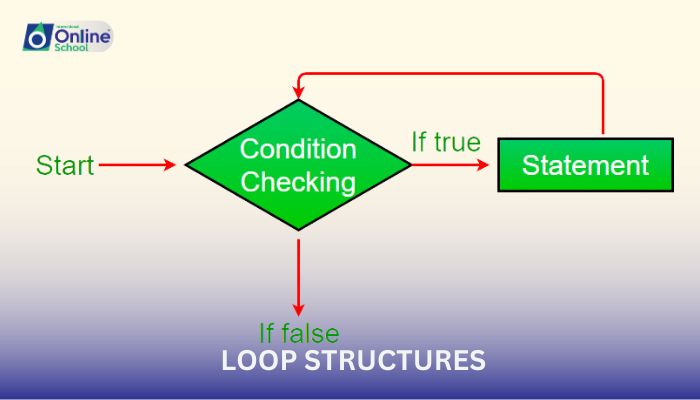
Loops are like hardworking robots who tirelessly repeat your commands. They let you tell them a single set of instructions, and like magic, they keep doing it until you tell them to stop! This saves you tons of time and effort, especially when you need to do the same thing many times.
ii. Benefits of Looping:
Remember the wall painting? Instead of writing the same code for each stroke, we can use a loop to paint the entire wall with just one command. This makes your code shorter, cleaner, and easier to understand. It's like writing a recipe - you wouldn't list every single stir of the spoon, right? Loops are the recipe shortcuts of programming!
iii. Types of Loops:
There are different types of loops for different jobs, just like you have different brushes for different surfaces. Here are some common ones:
For Loop: Perfect for painting sections of the wall with a specific number of strokes. You tell the loop how many times to repeat, and it does it exactly that many times.
While Loop: Great for painting until the job is done. Imagine checking if the paint is dry after each stroke - the loop keeps going until the wall is fully covered.
Do-While Loop: Similar to a "paint until dry" loop, but it always paints at least once, even if the wall is magically already dry!
Real-World Examples:
Loops are everywhere in the digital world! They track your score in games, play music on repeat, and even send you birthday wishes year after year. They're the hidden helpers that make programs run smoothly and efficiently. Loops are powerful tools that make programming easier and more fun. By understanding how they work and using them wisely, you can become a programming master, painting amazing digital creations with just a few strokes of code!
